Wednesday, January 9, 2013

Forgotten Great Civilisations (Igbo-Ukwu Culture)


History and archaeology have made it possible for us to remain in touch with lost or ancient (great) civilisations the world over through excavations and documentations. Sometimes, archaeology and ethnography which is the study of modern people in their natural settings can provide evidence that forces scholars to rethink the nature of the past. This was exactly what happened in the case when a site in the forest region of (Onitsha) Eastern Nigeria, Igbo-Ukwu, was discovered in the 1930s and 1940s, to contain the remnants of a complex, settled, agricultural society dating back as far as the 9th century AD. 
  
Igbo Ukwu Bronze Vessel
                                                          

This was the discovery – led by Thurstan Shaw, of a lost ancient culture/civilisation that was advanced in its days, and as such is very important historical evidence as regards the richness and contributions of this part that is today a part of modern Nigeria. Of particular interest is the source of the copper and lead used to make the sophisticated bronze wares, which may have been Tadmekka in the Sahara, and of the coloured glass beads, some of which may have come from Venice and India, the latter via trade routes through Egypt.

It is possible that the inhabitants of Igbo Ukwu were able to develop a metal working art over 1,000 years ago. Though the topic still remains controversial, what is known is that on this site have been revealed hundreds of ritual vessels and bronze casting that are among the most inventive and technically accomplished bronzes ever made. Igbo Ukwu craftsmen are believed to be the earliest copper smiths in West Africa; they also practiced the lost wax-casting method in their production of bronze artefacts. These casters were among the best the world has ever seen. Within discovery reactions were high, some scientists and historians suggest the Igbo Ukwu were taught these techniques by foreigners. However thus far, the metals were mined from nearby areas and the use of scarification show local origin and cultural continuity with modern day Igbo cultures.

Where have we missed it; what is the missing link? This is what we ought to be looking at today as a people in Nigeria.

In the past, scholars believed that such societies had been absent from African forest regions. They also believed that centralisation of some kind or another needed to accompany the development of complex societies. This segment uses Igbo-Ukwu to demonstrate that complex societies did not have to be centralised.

Indeed, a combination of archaeological evidence and the study of modern Ibo peoples in Nigeria led scholars to believe that the people of Igbo-Ukwu ordered their society through a well informed system of self-governing villages headed by family leaders. Instead of the highly stratified social hierarchy of centralised kingdoms or city-states, the social order of Igbo-Ukwu emphasised common goals and group achievements even in culture, administration, and technology, etc. The discovery of Igbo-Ukwu and its sophisticated art forms have provided yet another model by which scholars understand how ancient people ordered their worlds.

By Morgan Nwanguma

Sunday, December 23, 2012

A Priceless Artwork That is Beyond Insurance


Mona Lisa unlike most people would think is not actually an imaginary title of a piece of art work. Rather, this painting (1503-7), executed by the greatest artist and creative mind so far modern history has known, arguably, – the Italian Renaissance master, Leonardo da Vinci, and measuring 77cmx53cm, is the portrait of the wife of a local Italian peasant.

Mona Lisa


Today this painting also arguably, is the most important singular piece of artwork available today, both in terms of value, as well as popularity, and bearing in mind that it is after all not a very large scale job per se. The Mona Lisa is the most famous painting in the history of art and continues to inspire oil painting reproductions, parody, scientific theory, and more. According to the Guinness Book of world Records, Mona Lisa was assessed for insurance purposes at $100 million in 1962, but insurance was not concluded because the cost of the strictest security precautions was less that of the premium.

Mona Lisa which is housed in the popular (Gallery) Louvre in Paris, France, is a jealously and heavily guarded and secured piece of art. It is protected in a climate controlled environment and encased in bullet proof glass, a room which caused seven million dollars to build at the time. This painting which is considered priceless and cannot be insured has since become a proud property of the French people, and government, and has therefore survived more than 500 years today. 


By Morgan Nwanguma

Thursday, October 25, 2012

Will We Ever Learn?

Goethe Institute, Lagos recently staged an exhibition tagged 'Black.Light Project' (a photographic and Artist/Writers initiative) at the old Federal Government Press, No. 9, Broad Street, Lagos. It opened for public viewing and interaction on Saturday, 13th October, 2012. Black.Light Project is an artistic project which saw the coming together of like minds in Artists, Photographers, Writers, etc. who at one time or the other were in the thick, or mere observers, of the conflicts of the war torn West African states of Sierra Leone, Liberia, Ivory Coast, and Guinea Bissau, of not too distant memories.

The Black Light Project campaign 
The project is an epic documentation from 15 graphic storytelling artists from all over the world, who joined the project by merging writings and photographs with drawings depicting daily life and survival during the wars in these four countries. These conflicts that have left their big scars on the surface of the African continent and more, have been captured from the peering eyes of artists and downloaded in this powerful and concise graphic narratives, and is on tour of different continents of the world. Nimba – the War Lord says: “I have no need to be here.”

The desecration of peace and tranquillity, the rape of innocence by the whims and power cravings of the Samuel Does, Charles Taylors of this world, etc, can be seen in the general angst, reprisals, disillusionment in the faces of child soldiers, the black-out in an entire country such as Liberia, etc. But most importantly, these dark pictures with their graffiti and the stunning storylines should go a long way in awakening a continuous reflection and dialogue in our hearts. But will we ever learn our lessons?

By: Morgan Nwanguma


Monday, September 24, 2012

Sculpture in Nigeria

The practice of sculpture in Nigeria is more popular in the traditional sense than in the academic or modern sense because here, it is mainly the traditional wood carver, and also the traditional bronze casters of, especially Benin that still hold sway. Most of these of course fall under the category of religious, cult or tourism art. Much of the tourism sculptures are visible around the five star hotels that dot the landscapes of the major cities. Some of the popular items in this category of popular art include wood, ivory and metal sculptures. Academic sculpture is still to be given its pride of place by the authorities, and patronage is still at its low
ebb. It is however in the academic circles that academic art and sculpture is being exalted and propagated. This practice is however complemented by some of the exhibitions that are privately staged here and there from time to time as well as the activities of a few interior decorators that simply just live up to their name as decorators, that is. But in terms of public commissions, only a few important sculptures have been seen to be publicly commissioned or erected year in year out. We still look forward to greater improvements, and attaining the ideal which recognises that in the design or proposals for public buildings, due provisions should be made so as to incorporate artistic embellishments such as sculptures in the round, permanent installations, assemblages, and also ‘functional’ sculptures for instance as built into parks and gardens. Thus these are supposed to be so integrated as part and parcel of the overall projects. This has hardly been the case in Nigeria. Thus the government is yet to see reasons to institute endowments for the arts as is done in more civilised climes. The popular mediums or techniques so far employed in Nigeria are usually in the range of concrete, metal, marble, fibreglass, wood, etc. Some important artists of this genre however could be just to mention a few: Yusuf Grillo, Abayomi Barber, Ben Ekanem, Ben Enwonwu, Ndidi Dike, Olu Amoda, Matthew Ehizele, El Anatsui, etc. Morgan Chima Nwanguma

Friday, March 16, 2012

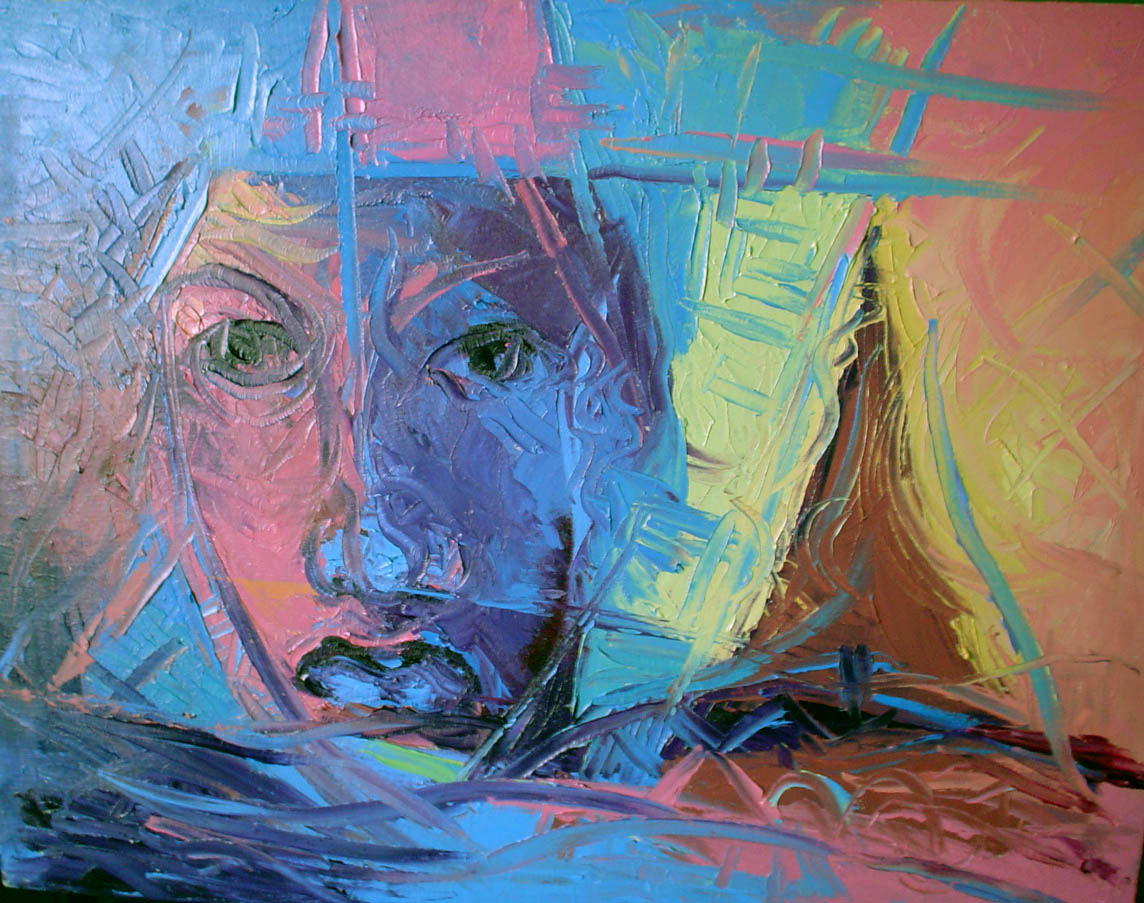
My Gallery

'Where are the prophets' - oil
'A Jazzy affair' - watercolour
'A problem of water' - oil on canvas
'Elation' - oil on canvas
'Face of Africa' - oil on canvas
'Mobile' - oil on canvas
'Power of love' - watercolour & ink
'Precious moments' - watercolour
'Somebody's home' - oil
'State of the Union' - watercolour & ink

Wednesday, March 14, 2012

I Remember Gani Odutokun

Gani Odutokun was one of the most talented, prolific and inspiring artists to come out of Nigeria this century. Gani was my lecturer and a great inspirer and motivator that had an unending strong influence on many of us who were privileged to have had training under him. His untimely death in a car crash in February of 1995 meant the loss of one of Nigeria's pioneers of Modern African art. Could it be just an irony of fate – Gani loved ‘accidents’? Thus his latter works were results of happenstance, and 'happy' accidents, from which he derived his unique liquidized oil painting technique. 

'Dry earth'  - liquidized (oil) painting by Gani Odutokun

Tuesday, July 19, 2011

WHAT IS AFRICAN ART? (1)

The meaning and purpose of art can be traced back to man’s earliest quest for survival. Thus the meaning, function and purpose of art in those days were quite different from what we would know of it today. Then, art only played a functional role. Early man learnt to fashion out tools, weapons and body coverings. Even the drawings done by the wizard artist were for magical purposes.

But as man developed further he even became superstitious, and thence emanated the ritual or religious purpose of art. But the most outstanding form of early-man’s art is the cave art: featuring drawings, paintings and etchings on the walls of caves. The purpose of these people for doing what they did have no doubt become different from what their legacies are for us today – hidden treasures of invaluable records. The artists were totally unbiased and true to their natural callings; responsive to their every social activities and events surrounding them. Art, be it as practised in the early times or as of today, would normally function in various ways. A piece of art work could perform social, domestic, religious or aesthetic functions.

Benin bronze head - an example of  traditional African art

But the question is – does African art perform different functions from European art for example? Are their roles supposed to be delimitated or specifically targeted towards a particular purpose? I would think that early-man art, and traditional art – being its immediate successor, could play the same roles be it in Africa, Europe, the Far East, the Americas or Oceania, etc.

Because of man’s level of development at this time, encumbered by superstition, animism crept into art. And also due to the level of interaction and non-commercialisation of man’s early art forms, there was maintained a strong level of seeming conservatism and therefore marked differences, and demarcations arose. And so one would want to ask – what is the noise all about African art? This is to say, looking at the concept, from the perspective in which the term is popularly viewed even in today’s modern world. I submit that there is African art, and there is also traditional art of Africa. So, if we set apart traditional African art, do we still have what is popularly touted as African art?

All in Your Eyes